From the moment our little ones learn to crawl, the journey to greater mobility begins. Bicycles often represent one of the major milestones for children, opening a new world of exploration and autonomy. However, as any parent will tell you, kids outgrow bikes almost as quickly as they outgrow their clothes. Today, we’re exploring an innovative solution to this issue: a bike designed to grow with your child simply by changing its orientation. If you're wondering how great product ideas come to life, here's a guide on how to invent an idea that can truly wow.
Kids’ bikes hold immense potential for design innovation, offering a world of opportunities to create joyful and safe adventures for young riders. From balance bikes for toddlers to advanced models for older children, each stage of a child’s cycling journey presents unique design challenges and possibilities. At the core of designing kids’ bikes lies the principle of balancing safety and fun. The first step is to ensure the right fit for different age groups. Smaller bikes with adjustable features cater to the growth of children, allowing them to feel comfortable and confident as they progress. Ergonomically designed handlebars, seats, and pedals support healthy postures and reduce the risk of strain or injury, encouraging a lifelong love for cycling.
The world of colors and graphics becomes a canvas for creativity in kids’ bike design. Bright and vibrant hues ignite the imagination and instantly attract young eyes. Customizable decals and themes inspired by popular characters or adventurous themes add a personal touch and emotional connection for young riders. Furthermore, incorporating interactive elements can transform kids’ bikes into interactive playmates. Integrated sound modules, LED lights, or motion sensors can create an immersive experience, sparking curiosity and encouraging outdoor play. These elements not only add excitement but also enhance visibility, ensuring safety during low-light conditions.
Innovations in materials also pave the way for more lightweight and durable bikes. Advancements in carbon fiber, aluminum alloys, and sustainable materials enable the creation of bikes that are easier to handle and eco-friendly. Additionally, integrating eco-conscious features, such as recycled components or environmentally friendly paints, aligns with the growing demand for sustainable products and instills environmental awareness from an early age. Adaptive and inclusive designs open up opportunities for children with physical disabilities to experience the joy of riding. Custom adaptations, such as hand-powered tricycles or adjustable supports, allow all children to participate in cycling activities and build precious memories of shared adventures. The incorporation of smart technology is another emerging area in kids’ bike design. Integration of IoT devices, such as GPS trackers, can provide parents with peace of mind by ensuring real-time location tracking. Additionally, gamification elements, through apps or digital platforms, can turn cycling into an interactive and educational experience.
The Challenge
Traditional kids’ bikes come in various sizes to accommodate different age groups, but their static nature presents a problem. Children grow rapidly, particularly during their formative years, necessitating frequent bike replacements. The financial burden of buying new bikes, not to mention the environmental implications of discarding old ones, highlight the need for a more sustainable solution.
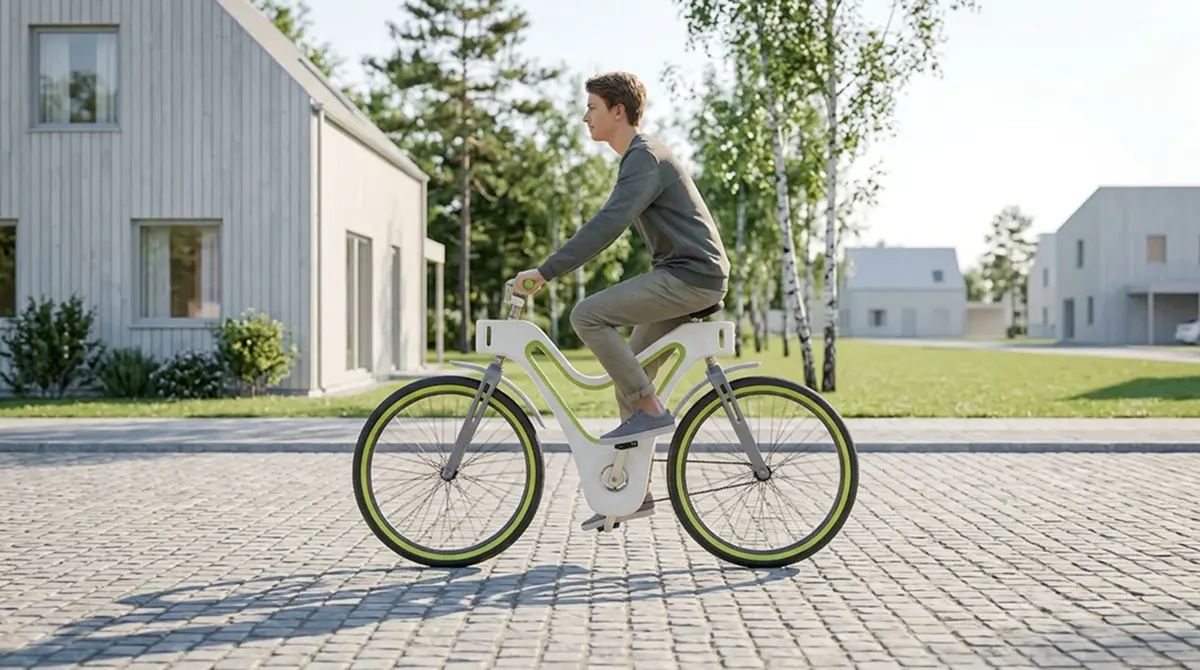
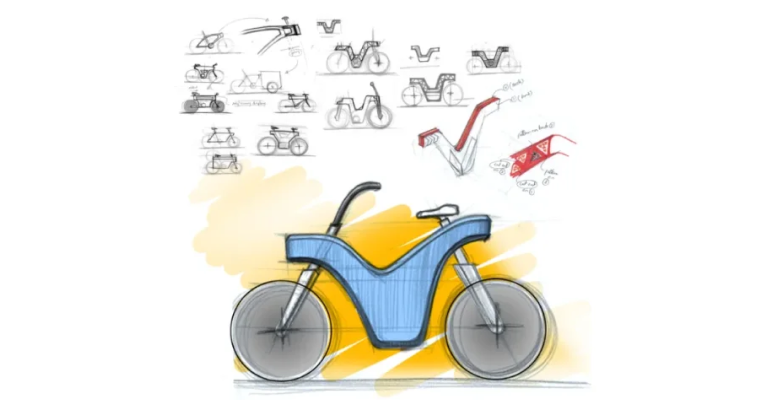
Our mission was to create a kid’s bike that could adjust to a child’s growth with a unique, straightforward mechanism: changing the orientation of the bike. The idea is to design a bike frame with an unconventional geometric shape that can be reoriented to fit different stages of a child’s growth, without needing to replace parts or buy new equipment.

The Design
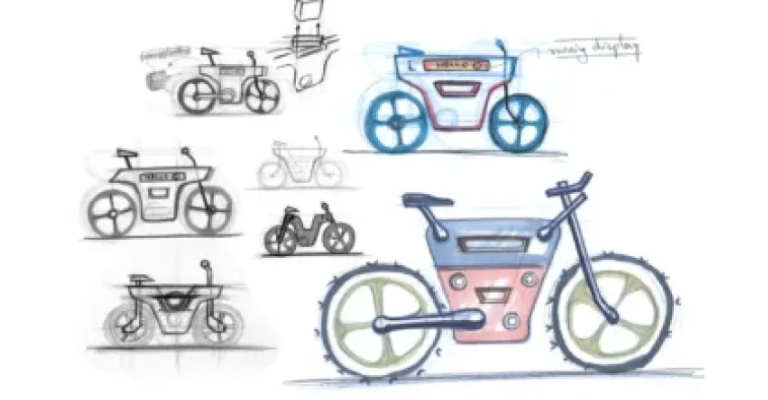
Our innovative bike design is based on a robust, adjustable geometric frame that can transform into different sizes and shapes. The bike starts in a small, stable configuration for young children learning to ride. As the child grows, the frame can be reconfigured by simply rotating parts, effectively lengthening the distance from the seat to the handlebars and raising the height of both. The frame is crafted from lightweight yet sturdy materials to ensure the bike remains safe and manageable, regardless of its size, the kind of material-forward thinking Yanko Design regularly spotlights as a defining quality of breakthrough product design concepts.
Here are ways to create a positive impact on creative ideas. You might also be interested in our Modular Bicycle.
What Parents Actually Wish the Bike Industry Knew
Talk to any parent who has bought a kids bike and you will hear a version of the same story. The bike arrives, the child loves it, six months pass, and suddenly the seat is too low, the reach feels cramped, and the whole thing belongs to a smaller child than the one pedalling around the driveway. The frustration is real, and it is one of those quiet problems that the industry has historically accepted as simply the nature of childhood. Kids grow. Buy another bike.
But that resignation is exactly where design has an opportunity to step in. When you start a project by listening to parents instead of just measuring children, the brief shifts completely. The question stops being "what size bike does a five-year-old need?" and starts becoming "how do we build something a family can trust across three or four years of a child's life?" Those two briefs produce radically different outcomes. One produces a product. The other produces a relationship.
The emotional weight of this distinction is easy to underestimate if you are approaching it purely as an engineering challenge. For many families, a bike is the backdrop to a child's first real experience of independence. The moment a child rides without a hand on the seat behind them is a moment parents remember for decades. A product that earns its place in that memory by lasting, adapting, and staying reliable carries far more meaning than its price tag suggests.
How Modular Thinking Changes Everything About Kid-Friendly Design
Most products designed for children are built around a fixed snapshot of who the child is at the time of purchase. Modular design challenges that assumption at its core. When a product is conceived as a system of interchangeable, reconfigurable parts rather than a single static object, the relationship between the product and the growing child becomes something genuinely dynamic.
The key insight that drives modular kids product design is that children develop unevenly. A child might be tall for their age but still developing the coordination of a younger rider. Another might be physically small but confident and skilled beyond their years. A one-size-fits-one-age approach fails both of them. A modular system that can be tuned across multiple dimensions, reach, height, geometry, resistance, gives parents and children the ability to dial in a fit that reflects the actual child in front of them rather than a statistical average.
The Parts That Actually Matter
When thinking about what to make modular in a growing kids bike, clarity on priorities keeps the design from becoming overcomplicated. The components worth building around adjustability are the ones that affect both safety and confidence most directly.
- Seat height and fore-aft position: These two adjustments affect whether a child can comfortably touch the ground and whether their knee angle at the pedal is healthy for their joints over long rides.
- Handlebar reach and height: Reach determines whether a child is hunched or stretched, both of which cause fatigue and reduce control. Getting this right builds confidence quickly.
- Brake lever reach: Adult brake levers are sized for adult hands. Adjustable lever reach means small fingers can actually engage the brakes fully, which is a genuine safety consideration.
- Wheel and frame scaling: The deepest level of modularity is the ability to swap or reorient frame sections as the child grows into a fundamentally larger geometry, keeping familiar components intact across the transition.
- Weight distribution: As children grow, the balance point that feels natural shifts. Modular frame geometries allow the centre of gravity to move forward or backward to match a child's evolving riding posture.
The Feeling of Confidence Is Actually Engineered
Ask a child why they love their bike and they will probably tell you something about speed, or the colour, or how far they can go. Ask them why they feel nervous on a bike that is slightly too big and they will struggle to explain it. They just feel wobbly. They feel like the bike is in charge rather than them. That feeling, so immediate and so physical, is entirely a product of design decisions made long before the bike arrived in their hands.
Confidence in young riders is built through what designers call the contact point experience: the three places where a child's body meets the machine, the seat, the handlebars, and the pedals. When all three are positioned correctly for a child's proportions, the bike feels like an extension of their body. When any one of them is off, the whole system feels foreign and effortful. This is why fit is a safety issue, a performance issue, and an emotional issue all at once. The psychology of early cycling experiences runs deeper than most people realise. Children who have a smooth, confidence-building introduction to independent riding tend to carry an association between cycling and capability that stays with them. Children who spend their early riding years wrestling with a bike that feels slightly wrong, always stretching, always compensating, often develop a more ambivalent relationship with the whole activity.
The product design choices made at the beginning of a child's cycling life have a real downstream effect on whether cycling becomes a lifelong habit or an abandoned phase.
Raising Sustainable Kids Starts With What You Buy Them
There is something quietly powerful about putting a sustainably designed product into a child's hands. Children absorb values through objects as much as through words. A bike built to last, built to adapt, built from materials chosen for their longevity and reduced environmental footprint, communicates something to a child about how we relate to the things we own. That message lands even when it is never spoken out loud.
The environmental case for a growing bike is straightforward when you lay out the numbers. A conventional approach to children's cycling might involve three or four separate bike purchases between the ages of three and ten. Each purchase involves raw material extraction, manufacturing energy, packaging, logistics, and eventually disposal. A single well-designed platform that adapts across those same years collapses that chain dramatically. Fewer units produced, fewer units discarded, a smaller total footprint for the same amount of riding.
Material choices amplify this further. Aluminium alloys chosen for their recyclability, powder coatings that avoid heavy metals, hardware designed to be replaced individually rather than requiring whole assembly swaps: these are design decisions that add up to a product with a genuinely better lifecycle story. Parents who care about these things are actively looking for products that match their values, and a kids bike that earns a sustainability story alongside its functional story has a meaningful edge in that conversation.
Safety Is a Design Language, Here Is How to Read It
When most people think about safety in kids bike design, they think about helmets and knee pads, the gear that goes around the bike. The design of the bike itself is often taken for granted as a safety variable. That assumption leaves a lot of potential on the table. A well-designed kids bike communicates safety through every detail of its geometry, its materials, its finishing, and its assembly.
Frame geometry is the most consequential safety variable in a bike that gets too little public attention. The relationship between the wheelbase, the centre of gravity, and the steering geometry determines how predictably the bike responds to a child's inputs. A bike that turns too sharply at low speed is terrifying for a beginner. A bike with too much trail in the steering feels sluggish and disconnected. Getting this balance right for a specific age range and skill level is real engineering work, and it shows in how quickly children build riding confidence on bikes where it has been done well. Children are extraordinarily sensitive to product quality even when they lack the vocabulary to describe it. A child on a well-built bike feels the difference in ways that directly affect their behaviour and their willingness to push their own limits.
Sharp edges on a frame that catches a shin during a fall, cable routing that snags a small hand, a brake lever that requires more grip strength than a seven-year-old possesses: these are details that register as experiences rather than specifications, and they shape whether a child trusts their bike or treats it warily. Designing safety into a kids bike means designing every detail as if the most important user is a small person who deserves the same quality of engineering attention as any adult rider.
Impact And Future Implications
This experiment represents a significant breakthrough in children’s bicycle design. By creating a bike that grows with the child, we eliminate the need for multiple bike purchases, reducing both the financial burden for families and the environmental impact, a real-world application of the circular economy principles the Ellen MacArthur Foundation has been driving across global product design. This design principle could also inspire other products made for children that experience similar 'outgrowing' issues the World Economic Forum has identified adaptive and circular product design as one of the most impactful levers for reducing global manufacturing waste. In conclusion, designing kids’ bikes is a delightful endeavor that requires a perfect blend of safety, innovation, and creativity. It presents designers with a canvas to create not just bikes, but unforgettable childhood memories and a foundation for a lifelong love for cycling and outdoor exploration.
Through careful consideration of fit, materials, interactive elements, and inclusive designs, kids’ bikes can become much more than just a means of transportation; they become a source of joy, growth, and shared adventures for children and families alike.
Curious about how to turn a concept like this into a real product? Here's how to build a hardware product from scratch.
Have a product idea of your own? Explore our Product-Path™ to see how we can help bring it to life.